
Story branching
Real decision points rather than multiple-choice trivia. Learners choose, watch the consequence play out, and try again, the way instinct is built in real life.
Interactive, branching stories your people play, with pass marks, translations and export for your LMS, starring the characters they already know. Bite-sized, made in days, and the beginning of a campaign rather than the whole of it.
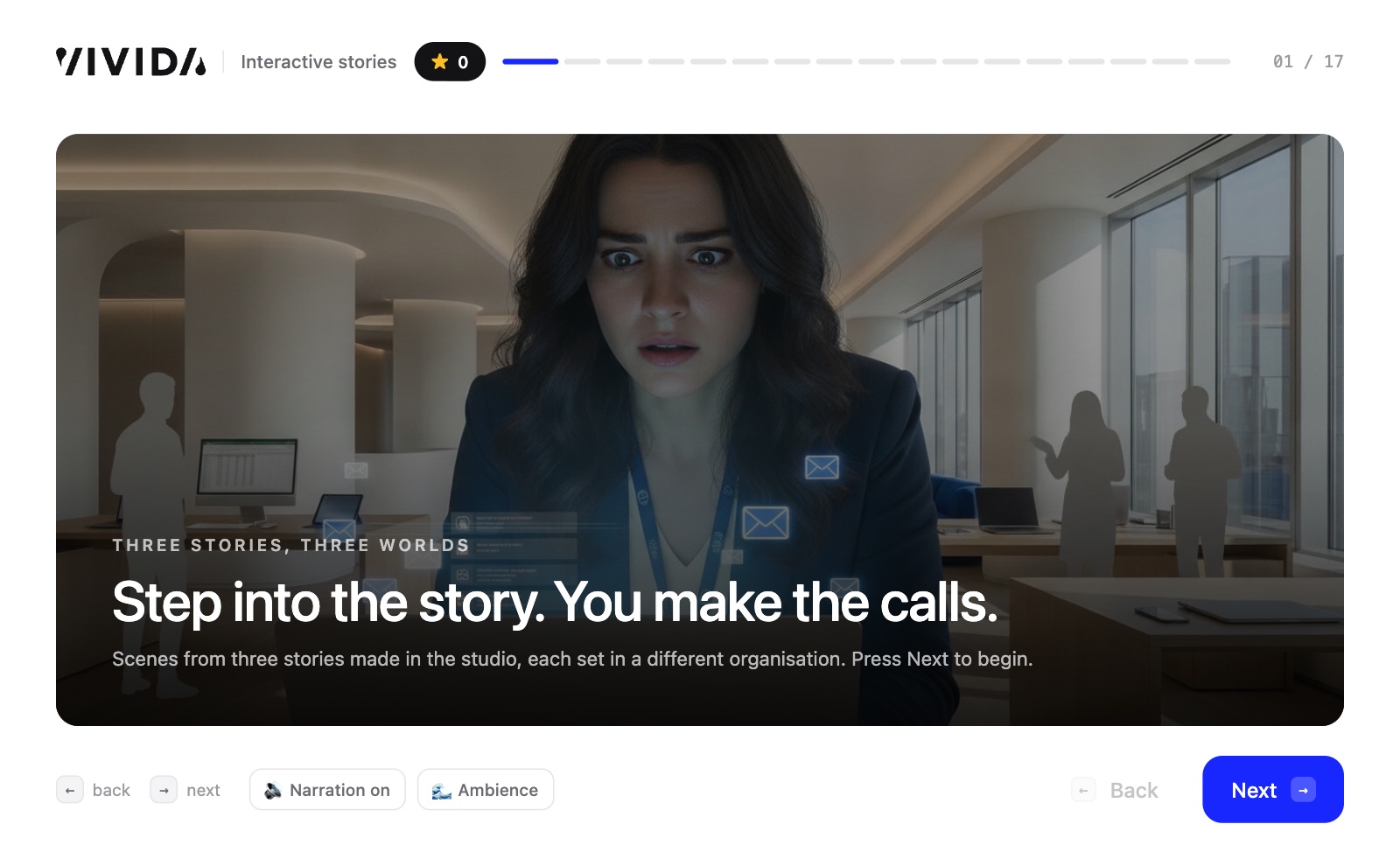
A trailer cut from three real stories made in the studio, each set in a different world, with decisions and consequences.
Prefer a bigger screen? Open the story full-window →
A professional services firm used a VIVIDA story module, and 1,300 of its 1,700 people completed it, without a mandate and without a chase.
Traditional modules take months to commission. Here, your world, voice and policies are already in place, so a new module goes from brief to draft in hours, and from draft to your people in days.
Pick the behaviour you need to land: a new scam, a policy change, an audit gap. Type it the way you would brief a colleague.
The studio drafts the scenario with characters your people already know: the decision points, the consequences, the pass mark.
Nothing publishes without someone on your team saying yes. Wording changes are always free.
Export it for your LMS, or share it by link into Slack, Teams or email. Scores come back either way.
Real decision points rather than multiple-choice trivia. Learners choose, watch the consequence play out, and try again, the way instinct is built in real life.
Graded outcomes with pass marks and scores, so completion means comprehension.
Stories translate into your chosen languages, narration included, and you sign off each one. One production reaches every region.
Every module exports to SCORM 1.2, self-contained or hosted, with scores reported back. No rip-and-replace, and no new system to roll out.
No LMS required. Drop a module into Slack, Teams, Viva Engage or an email. Play analytics show where it was opened, in which language, and how people scored.
Every module is tagged to the behaviour it targets and audited against SebDB, the open security behaviours database, your written policies and your tone of voice.
For most organisations the learning management system is the delivery route that matters, so everything is exported for it, in the format it takes, ready to upload. There is no integration to buy and none to wait for. It is your content, and the export is free.
Delivered through your own systems, with engagement data returned to you: what was opened, watched and completed.
The characters your people meet in training do not have to stay there. The same cast, in the same world, goes on to the reel in the feed, the graphic on the intranet and the screen in reception, so the module and everything around it read as one piece of work. That is how a module starts to build a security culture, change behaviour and carry a campaign.

 Video reel 9:16, for feeds and chat
 Graphic 4:3, for the intranet and email
 Wide image 16:9, for screens and slides
“It’s like you’re creating the brand. Those characters are you. We don’t have that here.”
Most organisations can plan the year’s training. Very few can respond when a new risk appears. The studio does both, in the same world.
Your mandatory curriculum, annual obligations and highest-risk behaviours, laid out in advance and made properly in your world.
A new risk appears on Monday. Bite-sized learning on it reaches your people by Thursday, in the same world, so it never looks bolted on.
Awareness platforms give you a library that cannot respond. Agencies give you response at a price you can pay once a year.
A phishing email from a sender they almost trust. A caller who knows just enough to be convincing. A screen left on show. Your cast faces the same decisions your people face, and because learners choose, fail safely and replay, the right instinct is rehearsed where a slide is only read. That is what a pass mark is actually measuring.
Bring a security priority to the demo. Watch it become a playable, graded module, in your world.